More to know about Grand Junction, CO – contact Paul Aspelin. Residential Real Estate For Sale. Text/Call 612-306-9558. Move to Grand Junction, CO

Celebrating Feedspot.com Recognition and the Western Slope Lifestyle

30 Best Colorado Blogs by Feedspot.com badge for 2025 because #15 is movetograndjunction.comMoveToGrandJunction.com has been recognized as one of Feedspot’s 30 Best Colorado Blogs and Websites in 2025! We are the only real estate and relocation blog from Grand Junction or the Western Slope to earn a spot on the list, highlighting trusted Grand Junction relocation insights and resources.

Feedspot.com reviews thousands of blogs each year, evaluating content quality, consistency, authority, and reader engagement. To be recognized alongside major statewide publications is an incredible confirmation that the hyper-local guidance we provide for people moving to Grand Junction truly matters.

This recognition is about more than just awards — it’s about celebrating the Western Slope lifestyle and helping people discover everything this region has to offer. From its outdoor adventures to unique neighborhoods and vibrant communities, we’re proud to showcase the best of life on the Western Slope.

Learn more about me.

Why This Recognition Matters

Recognition is exciting, but the real value comes from what this means for the people using MoveToGrandJunction.com as a trusted Grand Junction relocation blog and Western Slope relocation resource.

  1. Trustworthy, Reliable Information
    Feedspot’s editorial team selected the Top 30 Colorado blogs based on content quality, accuracy, and value. Readers can rely on MoveToGrandJunction.com as one of the most trusted and original real estate resources for relocating to Grand Junction and the Western Slope.
  2. A Fresh, Local Perspective — Not Generic “Copy-Paste” Content
    Most relocation blogs are written by writers who have never set foot in Mesa County. Every article on my Move To Grand Junction blog is based on 25+ years of real estate experience, an understanding of the Western Slope lifestyle, a “never stop exploring” attitude, and countless conversations with people considering a move to Grand Junction. This ensures hyper-local guidance and practical tips you won’t find on generic relocation sites.

“Paul went above and beyond expectations- all done with a respectful and caring attitude! Thank you so much!” – Chuck Weber

What Makes MoveToGrandJunction.com Stand Out

These are the qualities the Feedspot.com team looks for — and why the blog stands apart:

  • Hyper-local Accuracy: Every guide is based on actual experience living, exploring, and working in the Grand Junction area.
  • Real Relocation Guidance: From “Top Day Trips from Grand Junction” recommendations to local real estate insights, it’s built for real people making big decisions and real moves.
  • Human-Friendly Writing: Crafted to be approachable, useful, and actionable for anyone relocating to the Western Slope.
  • Market Insights You Won’t Find on Generic Real Estate Sites: The blog is backed by 25 years of real estate expertise and a love for taking care of people wanting to move to the Grand Valley.

Articles you might enjoy

A Big Thank You to Our Readers & Relocators

This recognition is exciting, but the real reward is knowing the content is helping visitors to this blog make informed decisions about moving to Grand Junction. Whether you’re researching neighborhoods, planning a visit, or moving across the country, I created this blog to help you feel confident about your choice — and to celebrate the Western Slope lifestyle along the way.

Your visits, questions, and feedback make this possible, and we couldn’t do it without you. Many of our Live Your Vacation blog posts are inspired from my conversations with people like you!

Please let us know what you’re thinking.

What’s Coming Next for MoveToGrandJunction.com

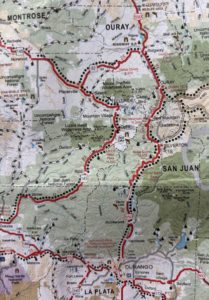
Map of Ouray, Silverton, Telluride area and Million Dollar HighwayFeedspot’s recognition motivates us to keep raising the bar. Here’s what’s in the pipeline:

Stay tuned — there’s a lot more coming for anyone considering a move to this incredible region. Please reach out with questions and comments as our conversations spark new blog posts.

Planning a Move to Grand Junction?

If you’re relocating to Grand Junction, explore all the guides, tools, and resources on our Living Your Vacation blog page or reach out directly for personalized help.

Start Your Move to Grand Junction Discussion Here → 

Start your home search with a local MLS source

Live Your Vacation in Grand Junction!

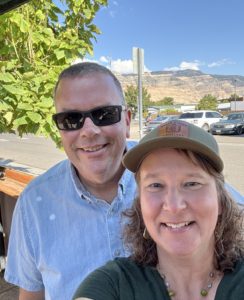
Michelle and Paul Aspelin at Peach Street Distillery in Palisade, CO
PAUL ASPELIN, REALTOR®
GRI, SRES®, CNE
Serving Grand Junction, Palisade, Fruita and all of Mesa County
Grand Junction Real Estate Expert
Text/Call 612-306-9558

Connect with me on LinkedIn

Paul Aspelin Reviews and Recommendations

© 2025 Paul Aspelin, REALTOR®. MovetoGrandJunction.com Copyright protected. All rights reserved.

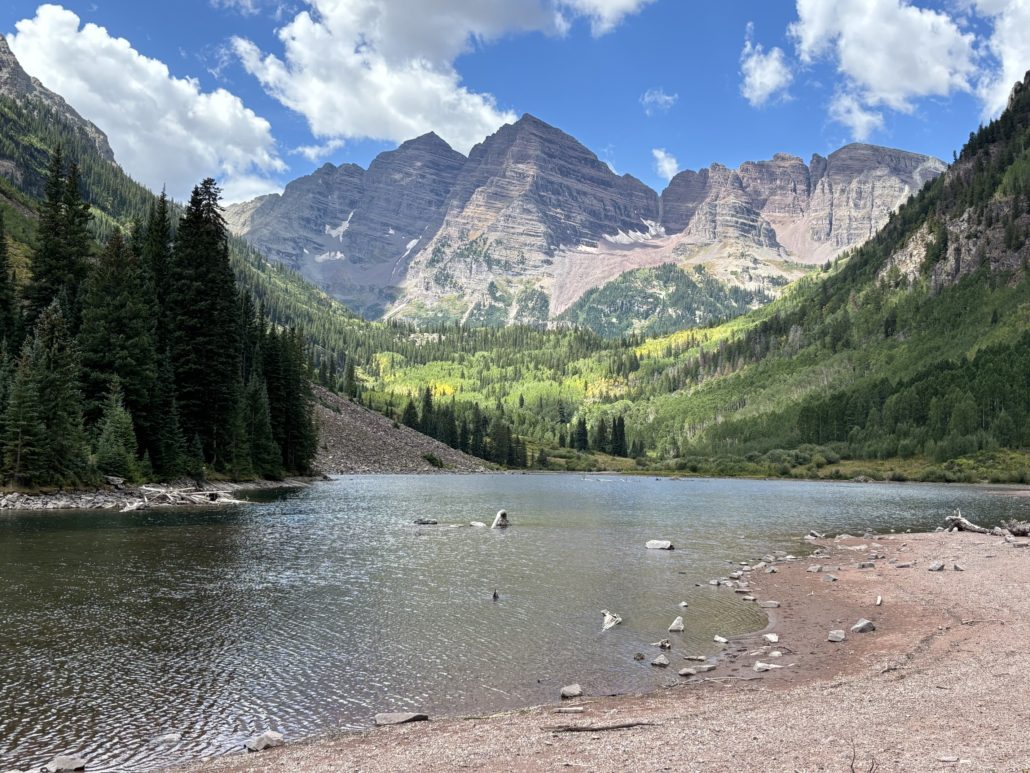
Photo below is from our day trip to the Maroon Bells area near Aspen/Snowmass. A wonderful trip with one of our daughters.

Top 30 Colorado Blogs award for movetograndjunction.com here's a photo of Maroon Bells near Aspen CO

If you spend any time outdoors in Grand Junction—hiking, walking around town, running errands, or heading out on day trips—you quickly learn that staying hydrated isn’t optional. The high desert climate, abundant sunshine, and elevation make having the right water bottle more important than most people expect—especially for anyone who’s new to living or recreating on the Western Slope.

Water Bottle Collection

Which water bottles we chose, how we use them, and where to get yours. This isn’t an article about the best water bottles, you can decide which ones are best for you. I just wanted to share the different ones we use and why so you can make informed decisions when you want to add to your water bottle collection. I have included some links to bottles or backpacks so you can get details about them and see what I’m talking about. They are not links to encourage online shopping, just to be informative. See the section below regarding the value of shopping in-person at REI.

YETI® Stainless Steel Water Bottles

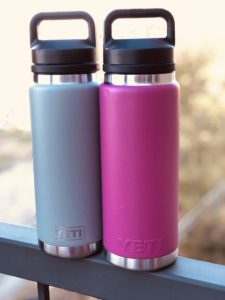
Our YETI Stainless Steel Reusable Water Bottles are also dishwasher safe

We chose the YETI® brand primarily because they are dishwasher safe. Other similar brands are not, and I don’t like to hand wash anything, so this was very important to us. However, many people put stickers on their water bottles, therefore, they need to wash them by hand. That’s why we don’t have stickers on ours.

The other important factor for choosing a YETI® water bottle is because it is important to us to have COLD water. Having an insulated water bottle was a priority for us. It makes it heavier, but we were willing to live with that drawback…initially. Then we started hiking longer, going further, then the weight can be a bigger negative than having water that isn’t cold.

YETI® and similar insulated stainless steel water bottle brands are fantastic for keeping your liquids cold for long periods of time. We chose the 26-ounce size bottle with what’s called a chug cap. It’s like a regular plastic water bottle opening. The cap includes a handle for easy carrying. They have other options with straws and flip-top lids. I didn’t want to keep a straw clean, so we chose bottles without straws.

I bring this one on short walks and carry it in my hand. For longer hikes, it fits in my backpack or on the side pouch of my backpack for easy access. It’s big but not too big. It’s 100% leakproof.

The downside is that it’s heavy. Therefore, our next purchase.

Nalgene Hard Plastic Water Bottles

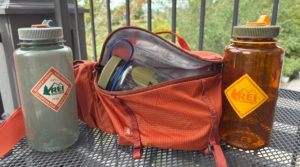
waist pack and 3 Nalgene hard plastic water bottlesWe originally bought a 32-ounce Nalgene bottle to carry extra water. Nalgene bottles are made of hard plastic, and they are not insulated. Michelle got a small waist pack to be able to carry this size bottle, and it fits in there perfectly. Her YETI® water bottle is too big. Sometimes you don’t want something in your hand when you are hiking so you can use your hands to stable yourself when you are climbing. Her pack is called the REI Trail 5 Waist Pack in case you want to see what it looks like.

We now have a couple of Nalgene bottles, and we use them to bring extra water. We keep them in our YETI® cooler. They come in a wide or small mouth. I recommend the wide mouth so you can easily put ice in it. If you don’t like drinking from the wide opening, like us, then you can get this stopper looking thing to make the opening smaller, so the ice doesn’t slam into your face when you are drinking. Yeah, you know what I’m talking about.

These are completely leakproof. They are dishwasher safe. Again, we don’t put stickers on these either but most everyone else does.

The downside is that they are not insulated so they don’t keep water cold. However, you can fill your Nalgene with ice, then add water, and you’ll get more water as it melts. So, this makes it good for shorter walks. Plus, it’s not too heavy.

Other Stainless Steel Water Bottles

We do have a couple of other stainless-steel water bottles we’ve collected over the years. They are smaller and fit in the cup holders in our vehicles. Some are the YETI® brand. Stainless steel is great for cold or hot beverages. I like the small size. I take these on short walks or offer them to our friends to use when they come to visit. Everyone needs a water bottle nearby in our warm climate. Read my post about Grand Junction weather and Summer Weather in Grand Junction.

Obviously, there are all sorts of water bottles out there. I’m just letting you know which ones we have and why. If you are ready to purchase some while you are here in Grand Junction, I highly recommend you shop at our local REI to choose the best water bottle that will work for you and your intended use.

Emma has a huge Hydro Flask water bottle and she got a special cup holder expander so she can keep her large bottle secured next to her while she’s driving.

Serious Hikers Use Water Bladders, also Called Water Reservoirs

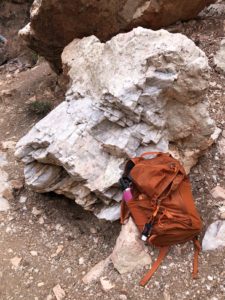
Flash 22 REI backpack resting on rocks near Mica Mine

Michelle’s Flash 22 REI backpack resting on rocks near Mica Mine trail in Grand Junction

We learned the hard way one time when we ran out of water. It was my birthday (May) and we hiked the Palisade Rim Trail with our daughter Emma. Because she’s a fast hiker and we are not, she let Michelle or I lead the way, set the pace. Well, let’s just say we got off the trail, twice, and our 2-hour hike turned into more like a 3.5 hour hike. And this trail has a steep upgrade at the beginning. We ran out of water at the top and still needed to come down.

Michelle’s small REI backpack (called a Flash 22) has a spot for a water bladder (water reservoir), and we went to REI after this trip to buy one. We keep it in the freezer, so it doesn’t get bacteria growth, and it will be ready to go when we need it. It holds 3 liters of water. If we go on a longer hike, like 3-4 hours she uses it. It’s a better way to carry more water. Hydration packs are designed to make drinking convenient and efficient. You don’t have to stop, or even slow down, to take a sip of water; you simply grab the drink tube that’s connected to the water reservoir. You don’t need to stop and pull a water bottle from a backpack.

Emma uses her small hiking vest that holds a water bladder all the time, even for short walks around town or when we go to the Palisade Farmers Market. REI has a large selection of backpacks, hydration packs, hydration vests, hip packs, and water carrying backpacks you can consider.

Why Buy at REI?

You’ve got to go to REI and ask for Josh Kolb, our son-in-law. He’s a local expert and can explain, in detail, the pros and cons of all water bottle styles, sizes, brands and their reliability. You get to pick out the one you like the best, in your favorite color, and bring it home. It’s a much better experience than going online, reading the ratings and reviews, hoping you chose the right one, and then waiting for it to be shipped to you.

The best thing about shopping for your water bottles at REI is that you get valuable LOCAL advice. If Josh isn’t working when you stop in, that’s ok. Everyone there is very knowledgeable, helpful, and friendly.

The reason we buy our water bottles and other outdoor gear there is because of their generous return policy. If you don’t like it, or it doesn’t work as expected, you can bring it back. No need to package it up and bring it to the post office or a shipping location. Just walk through the door and they’ll take care of you. Ask me about the time we had 45 minutes to buy Emma a mountain bike when we brought her to CMU for college. We went straight to REI because we knew she could easily return it if it wasn’t right.  I mention REI in our post about Parent Tips for CMU families.

I also highly recommend you become a REI Member to take advantage of special sale coupons and an annual rebate check based on how much you’ve purchased. And if you want to go one step further, Josh can explain the multiple benefits of having the REI Credit Card. It has a fantastic sign-up offer! Grand Junction REI is located at 925 Independent Ave, Grand Junction, CO 81505.

Types of Coolers

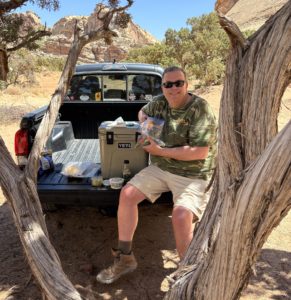
Picnic in campground under the shade of a tree

We ate a picnic lunch in a campground under the shade of a tree near Goblin Valley in Utah

On a related note, I wanted to share two things we learned about our YETI® Roadie Cooler since moving to Grand Junction. The Roadie Cooler is a great size for day trips when you want enough space for beverages, lunch, and snacks and you won’t break your back carrying it. It has a great shoulder strap!

In the beginning, ours wasn’t keeping our items as cold as we thought it would. That’s when Josh asked if we were “pre-cooling it”. What? We had no idea.

The night before, we now put an ice pack in the cooler to start cooling it down. Before we leave, we take that one out and put it back in the freezer. We put fresh frozen packs in the cooler, and we go. That helped but it still didn’t seem like it was keeping our drinks cold for a long period of time.

Then Josh said it’s better to have one large block of ice instead of several smaller ones. When Emma and Josh go on 5-day river trips, they need their food to be kept cold for the entire trip. They can’t afford it to spoil. They buy blocks of ice from the grocery store or a gas station so their large YETI® coolers stay cold!

I also decided that freezing individual plastic water bottles is way better than using our 20-year-old ice packs. LOL. We do this for two reasons. As the ice melts, we now have more clean water available to drink if we need it. And having the thicker frozen bottle is better than the thin ice packs we were using. Now we know!

If we are staying local or won’t be gone the entire day, we have 2 smaller collapsible bag coolers (similar to this one at REI) that do a great job too. Ironically, they were gifts from a lender and a title company, so we didn’t shop for them. But they do the trick to keep up to 6-8 cans or bottles of drinks cold or a couple of snacks, dip or salsa. Plus, they have pockets for napkins, silverware and a garbage bag. I use these bag style coolers to keep drinks cold when I take clients around the Grand Valley. Everyone needs to stay hydrated. You can read my related post about how to avoid altitude sickness and the importance of drinking enough water.

I hope you learned something new about water bottles, and I hope you shop at REI when you are in Grand Junction. If you are coming to the area, let me know if you’d like a tour. I’d be happy to show you around. And yes, we can stop at REI along the way if you want to pick up a new water bottle to use while you are here.

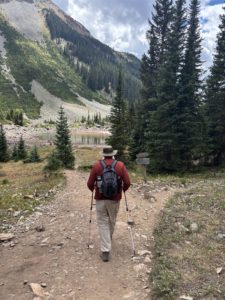
Paul Aspelin hiking to Crater Lake near Maroon Bells Aspen area with Yeti water bottle sticking out of backpack

Hiking to Crater Lake near Maroon Bells/Aspen area with my YETI water bottle in my backpack.

Check out REI when you come to Grand Junction!

Are you seriously thinking of moving to Grand Junction? Here’s my suggestion for Getting Started!

PAUL ASPELIN, REALTOR®
GRI, SRES®, CNE

Your Grand Junction Real Estate Expert
Live Your Vacation in Grand Junction!

Follow me on Facebook:
https://www.facebook.com/LiveYourVacationinGrandJunction

Text/Call me at 612-306-9558

Connect with me on LinkedIn or send me an email.
Serving Mesa County and the Grand Valley of Colorado.

© 2025 Paul Aspelin, REALTOR® MovetoGrandJunction.com Copyright protected. All rights reserved.

The summer weather in Grand Junction can get hot, but not too hot!

I wrote a post called Grand Junction Weather that summarizes the seasons we experience. It outlines the varying temperatures in the Grand Valley (which includes Fruita, Grand Junction and Palisade). I also wrote one called Winter Weather in Grand Junction. Now it’s time to give you some insight on summer weather in Grand Junction.

Before we came to Grand Junction the first time, we didn’t even know Colorado had high desert. We thought it was all about that great “Rocky Mountain high” that John Denver sang about. (You can connect with nature in the John Denver Sanctuary in downtown Aspen, CO. Cool place!)

How Does Summer Weather in Grand Junction Compare to Other Cities?

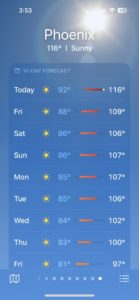
phoenix weather forecast showing highs over 100 and lows in the mid 80'sIf you live in Phoenix, it’s hot. Temps well over 100°F during the long summer, sometimes 115°F or higher! Phoenix is significantly warmer with temperatures rarely dropping below 80°. Summer weather in Grand Junction is hot, but it’s not too hot. Because of the lack of humidity 95°F feels like 88°F to us. It’s not so hot that you want to stay indoors all day during the summer. And we don’t get dust storms or monsoons like Phoenix, AZ.

What about Texas? Texas is hot too. Austin, has a humid subtropical climate with long, hot summers, and mild winters. Texas gets a lot more rain than we do. Severe thunderstorms and flooding occur. A temp like 95° in Austin, TX feels like 106° because of the humidity. Florida and the southeast in general are similar, with lots of humidity.

How about St. Louis? Summers are also hot, with highs in the lower 90’s, but the humidity makes it feel even hotter (heat index values can reach up to 102°F). And the Midwest gets tornados. We don’t get a lot of severe weather here. The risk of a tornado in Grand Junction is much lower than in the rest of the state of Colorado and elsewhere. I had to research to see if there ever has been a tornado here. I found an article written in 2023 that said there have been a total of 10 tornados in Mesa County. That’s very, very low!

No hurricanes or extremely volatile storms. I rarely hear thunder or see lightening. We do get some wind, occasional hail, and we need to be mindful about fire restrictions during the summer to avoid forest fires.

It’s a Dry Heat

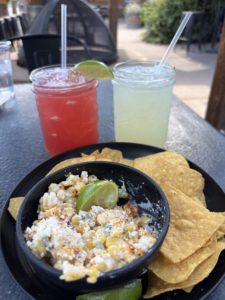
Peach Street Distillers Corn Dip and Chips and Drinks

Peach Street Distillers Corn Dip and Margaritas

I’m sure you’ve heard the phrase “but it’s a dry heat” from those of us who live in a high desert environment. I understood what people were saying before we visited but I didn’t really appreciate it until we spent more time in Grand Junction and western Colorado. We would do an activity outside during the summer and I wondered why I wasn’t sweating. I was, it was just evaporating so quickly that I didn’t notice. That’s why everyone here says to drink plenty of water. You don’t realize you are losing water because you don’t get sweaty just walking around like you do in more humid environments.

Because the summer temperatures are comfortable, we like to dine outside whenever possible. Many of the local establishments have outdoor patios or rooftop decks. Some are in the sun while others offer shade. Grand Junction, Fruita and Palisade are all very dog friendly. You’ll often see water bowls for dogs along the sidewalk and on restaurant patios.

If you feel warm, try some outdoor water activities like floating down the Colorado River, boating at Highline Lake State Park, or fishing up on the Mesa.

Overnight Temps Drop

Because Grand Junction is in the desert, it cools off at night. For example, in August it might get to 95°F during the day but that’s from about 2pm to 5pm. In the morning, we start out in the 70’s between 7am to 9am. A great time to have your morning tea or coffee outdoors. And after the sun sets our overnight lows are in the 60’s. We often sit outside after dark comfortably. We don’t wake up and say it’s hot right away, because it’s not. Mornings and evenings are very different than midday because we are in the desert. And if you are in the shade vs the sun makes a big difference too. We really do enjoy the summer weather in Grand Junction, day and night.

Bugs, what bugs?

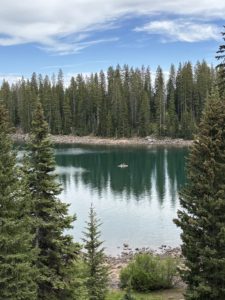
Island Lake on the Grand Mesa

Island Lake on the Grand Mesa taken near the boat launch and campgrounds

If you live in the Midwest, when you read the line above about us sitting outside comfortably after dark you probably laughed, right? You thought the mosquitos would carry us away! We don’t really have mosquitoes in Grand Junction. Maybe there are some by the Colorado River or other small creeks and streams. But in general, we don’t see them. Now, if you go up on the Grand Mesa, they have mosquitoes there because they also have 300+ lakes in the forest. That’s 45 minutes southeast of us. So we do bring our bug spray when we go up there during the summer until about mid-September. After the first frost, no bugs up there either.

My point is, if you are searching for a new place to live, keep reading about Grand Junction, Fruita, Palisade and Mesa County here on the western slope of Colorado. Consider moving to Colorado.

If you want a mild climate and all four seasons, move to Grand Junction. If you want to downhill ski in the morning and golf in the afternoon, move to Grand Junction. If you want to sell your snow shovel and snow blower and be done with icy conditions, move to Grand Junction. If you want to experience around 300 days of sunshine per year, move to Grand Junction. If you want to live in a place that offers outdoor activities and recreation year round, you guessed it, move to Grand Junction! And that goes for Fruita and Palisade too!

Learn more about my experience and how I serve my clients. If you are 50+ you might also like my post called Retire in Grand Junction: Your grandkids and kids will thank you, and my post about not waiting, semi-retire in Grand Junction. We will welcome you with open arms.

Ready to look for homes in Grand Junction, Palisade or Fruita, here’s how you get started!

Coming for a Visit? Let me give you a tour!

Michelle and Paul Aspelin at Peach Street Distillery in Palisade, CO

Dining outside at Peach Street Distillers in Palisade, CO

Text/Call 612-306-9558

PAUL ASPELIN, REALTOR®
GRI, SRES®, CNE
Serving clients since 2001

Grand Junction Real Estate Expert
Connect with me on LinkedIn or send me an email.

© 2025 Paul Aspelin, REALTOR® MovetoGrandJunction.com Copyright protected. All rights reserved.
If you are moving here from another state, you may be wondering about the Grand Junction Water Supply. Where does Grand Junction get its drinking water? Does it taste good? Does the city supply water for irrigation? Do homeowners have their own wells? We have learned a lot living here and I am happy to share our knowledge and experience with you. If you are considering moving to Grand Junction, call me before you come for a visit!

Grand Mesa Overlook near the Grand Mesa Visitor Center

Grand Mesa overlook along Hwy 65 just past Powderhorn Ski Resort

Where Does Grand Junction Get Its Drinking Water?

Let’s start with the most popular question I get. Where does our water come from? We are lucky. We are the first ones to use the fresh snowmelt from the Grand Mesa as our drinking water. It’s stored in over 19 reservoirs on top of the Grand Mesa, the largest flattop mountain in the world just 45 minutes east of here. It comes into Orchard Mesa to be treated and disbursed into our homes. Grand Junction provides water that exceeds the minimum standards for municipal drinking water.

In 2023, Grand Junction entered a drinking water taste test in Toronto, Canada. A city in Canada won first place, but Grand Junction won second place! Essentially saying we provide the best drinking water in the United States! Please thank Randi Kim, the utilities director for the City of Grand Junction for this!

Here’s a link to the American Water Works Association’s Best of the Best Water Taste Test Competition article with details. Awarded Best in the United States.

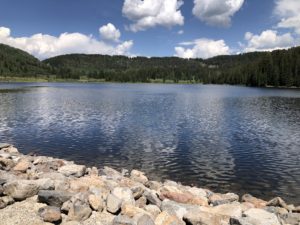
Grand Junction Water Supply starts here. Carson Lake view from standing on the dam

Carson Lake view from standing on the dam – Grand Junction Water supply starts here.

We have been to Carson Lake on the Grand Mesa which is at the head of the Kannah Creek Basin in the Grand Mesa National Forest. There were signs in the parking lot warning not to use motorized boats on the lake as it’s used to provide drinking water for the surrounding area. It’s beautiful. You can walk across the dam, there are trails nearby and we saw several groups fishing from the shore.

Does Grand Junction’s Water Taste Good?

YES! Every time we go to a restaurant, we order water. We drink it and it’s delicious. I can’t say that for other places we’ve visited. Sometimes their local water is so bad we need to order a pop or lemonade instead. If you currently use a home water filtration system where you live now, you probably won’t need one if you move to the Grand Valley. Try it for yourself and you’ll understand what I mean. We are thankful for our Grand Junction water supply from the Grand Mesa!

Living in Minnesota most of our water came from underground. The city built wells to access it. We got our water from our local city, and we drank it and used it to water our yard. We even had to add our own water softener because the water was “hard” and unpleasant to drink. In addition to that, we also added a Culligan water filtration system. Not here!

Where Does Irrigation Water Come From?

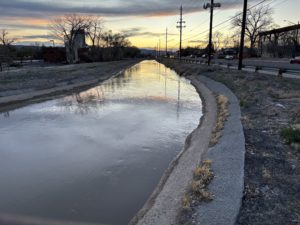
Canal along Patterson Road near 12th Street

Canal along Patterson Road near 12th Street

This system was new to me. Ag water or irrigation water is different from drinking water.

If you have visited, you may have seen canals running through town and in rural areas. They look like concrete ditches. Simply put, water gets diverted from the Colorado River near Palisade. It flows through an extensive canal system serving the whole Grand Valley. Water that isn’t used for irrigation is returned to the Colorado River to serve more communities downriver. Water conservation is always encouraged. We have been in a drought for several years.

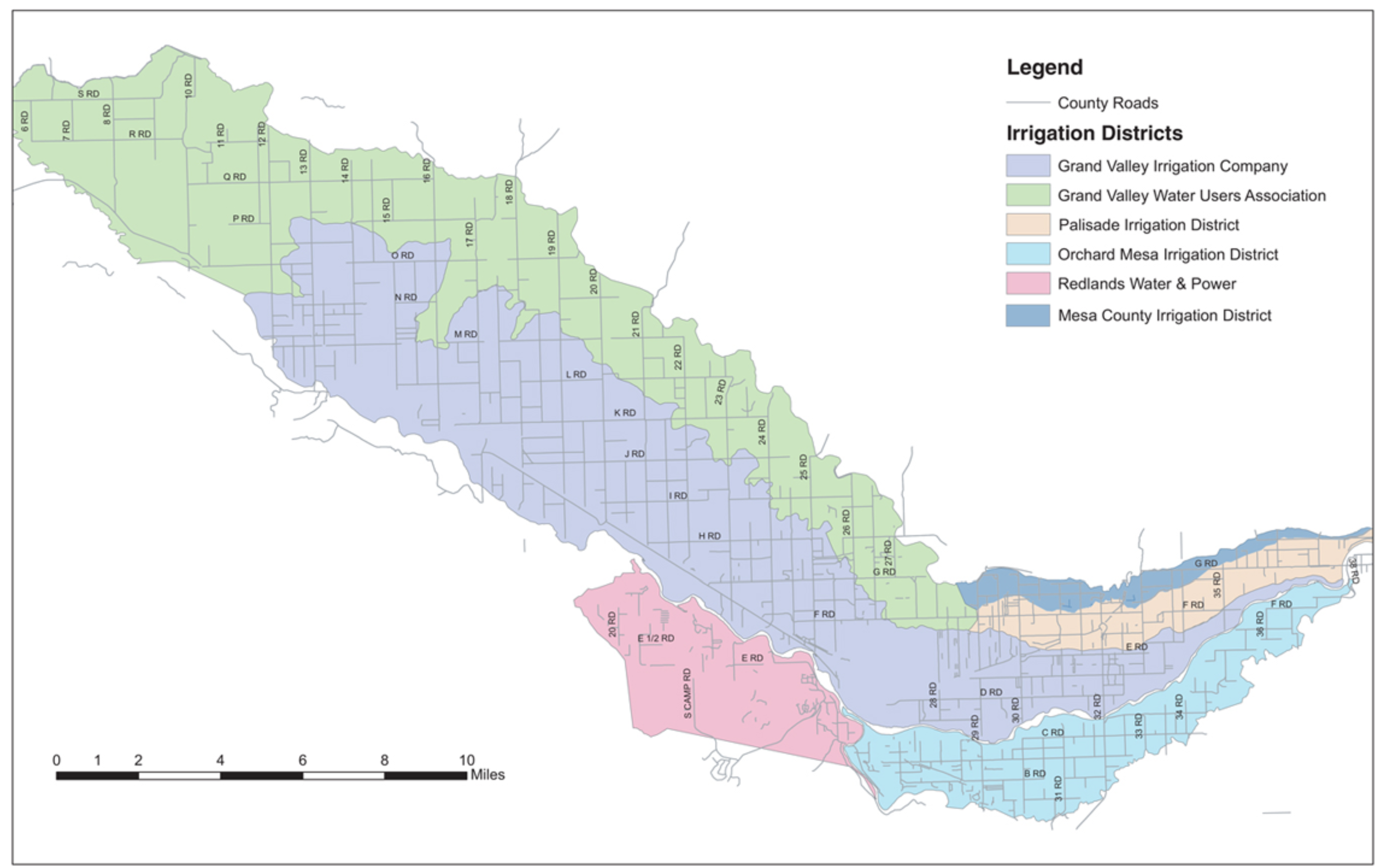
There are six irrigation districts that serve the Grand Valley. Below is a map from the Mesa County Irrigation District’s website. The City of Grand Junction has a lot of information about water on their website including water supply, treatment, and distribution.

I had a client who lived on the Grand Mesa just outside the town of Mesa and they drove to Palisade to fill their water tank (strapped inside the bed of their pickup truck) to bring water back to their property. The city’s website includes information on filling stations for those in rural areas who do not have water brought to their property.

Irrigation District map

Property Water Rights

If you buy a property here, you may have water rights or water shares. You can buy a small amount of water or more, depending on your needs. Many homeowner associations manage the irrigation water access for their neighborhood.

The Grand Valley Irrigation Company explains it very well on their website for the landowners they serve.

“The Grand Valley Irrigation Company serves a variety of land-types, including farms, farmettes, subdivisions, residences, and municipal properties. There are 48,000 shares of capitol stock held by over 3,000 shareholders. Each share of water gives the owner the right to approximately 4.6 gallons per minute. This is not a storage right, meaning that the water right does not accumulate and store up when it is not being used. It is a direct flow right, meaning that 4.6 gallons per minute can be drawn at any particular time to be put to beneficial use.

GVIC levies an assessment, or bill, annually on all shareholders. The first share owned by every account is designated as an A share. Each account has only a single A share. Any additional shares owned by a shareholder are categorized as B shares. There is no difference between an A or B share with regard to the water right that is granted. Both types of shares entitle the shareholder to 4.6 gallons per minute. Rather, an A share is assessed, or billed, annually at a higher rate than a B share.

For the 2025 irrigation season, an A share is assessed at $342.64 and a B share is assessed at $16.39.

As an example, if a shareholder owned 5 shares the annual assessment would be calculated as follows: $342.64 + ($16.39 x 4) = $408.20. The annual water assessment is sent out in early January and payment is due in full by April 1.”

Grand Junction Water Conservation

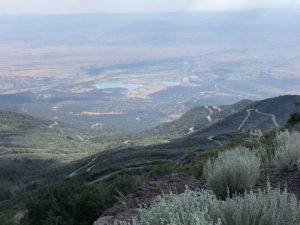
Standing on the Grand Mesa looking down into the Kannah Creek watershed, you can see Land’s End curvy gravel road that’s closed in winter!

If I kept going, I could write another 1,000 words about water conservation in the Grand Valley and Colorado in general. The city and county have conservation initiatives. There are many local, regional, and state nonprofit organizations, districts and institutions who help preserve this precious natural resource.

As a Colorado resident, we try to conserve water. We know that the water from the Colorado River flows southwest to serve Utah, Arizona, Nevada and California residents with water too.

We are thankful our Grand Junction water supply for drinking water comes from Kannah Creek and the Grand Mesa. When you are here, consider a visit to Carson Lake. It’s sort of near the Land’s End Observatory, an outstanding overlook of the entire Grand Valley, best experienced at sunset! I mention it in my post called What It’s Link to Live on the Grand Mesa.

Move to Grand Junction, we’re waiting for you!

Text/Call me at 612-306-9558

Contact me directly regarding non-MLS listings.

PAUL ASPELIN, REALTOR®
GRI, SRES®, CNE
Licensed in Colorado

Connect with me on LinkedIn or send me an email.
Learn more about my real estate experience and how I serve my clients 

© 2025 Paul Aspelin, REALTOR®. MovetoGrandJunction.com Copyright protected. All rights reserved.

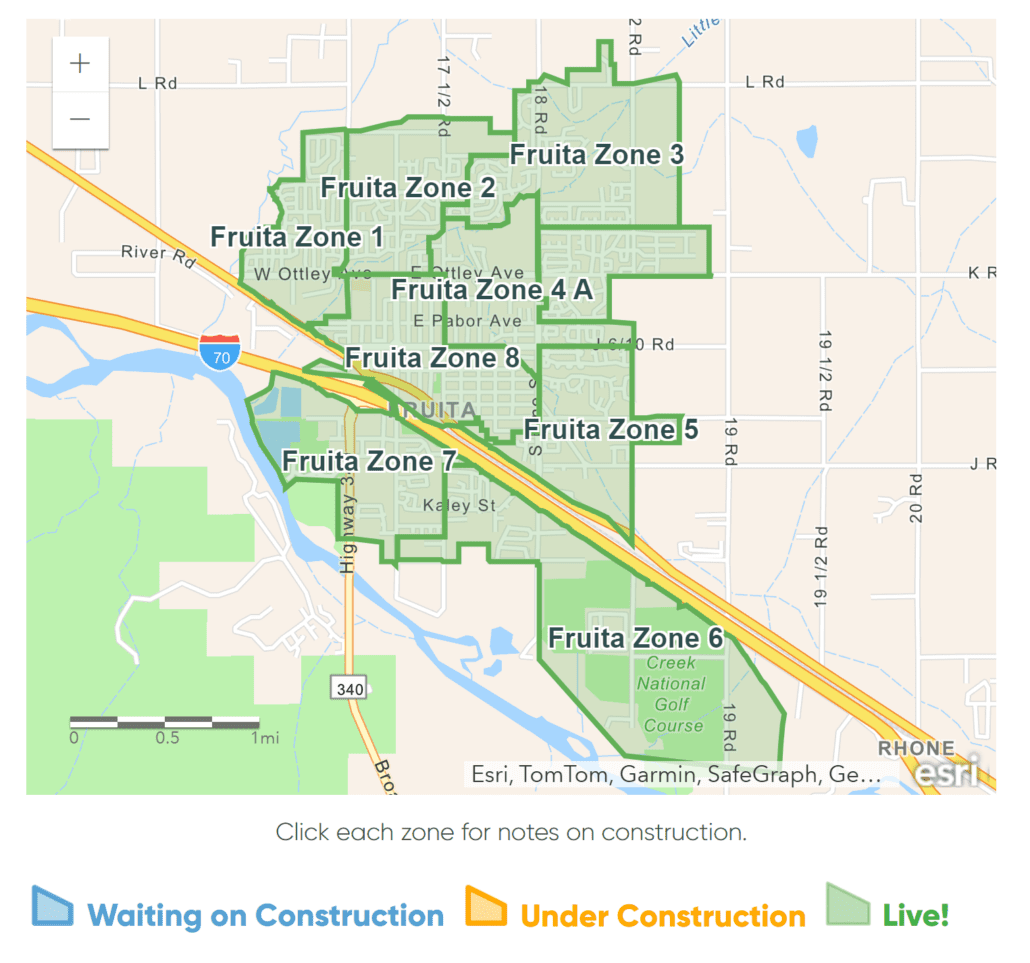
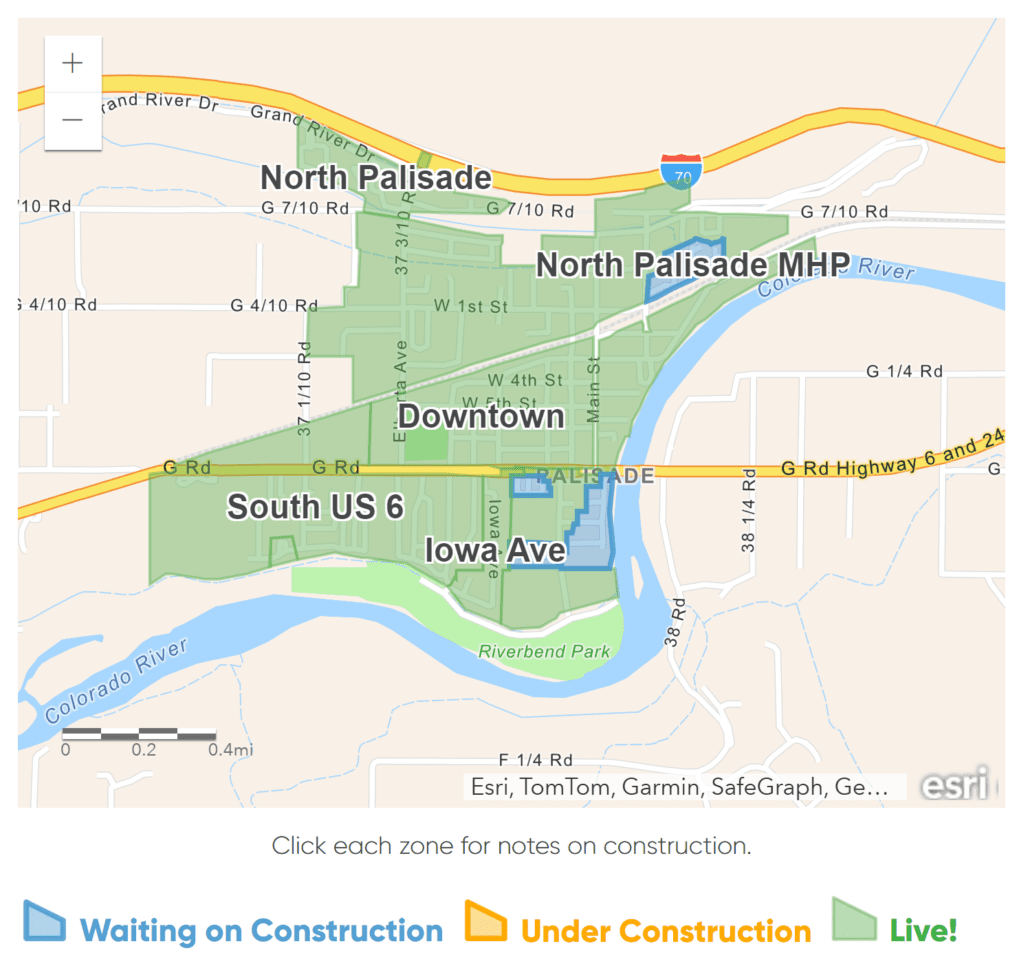
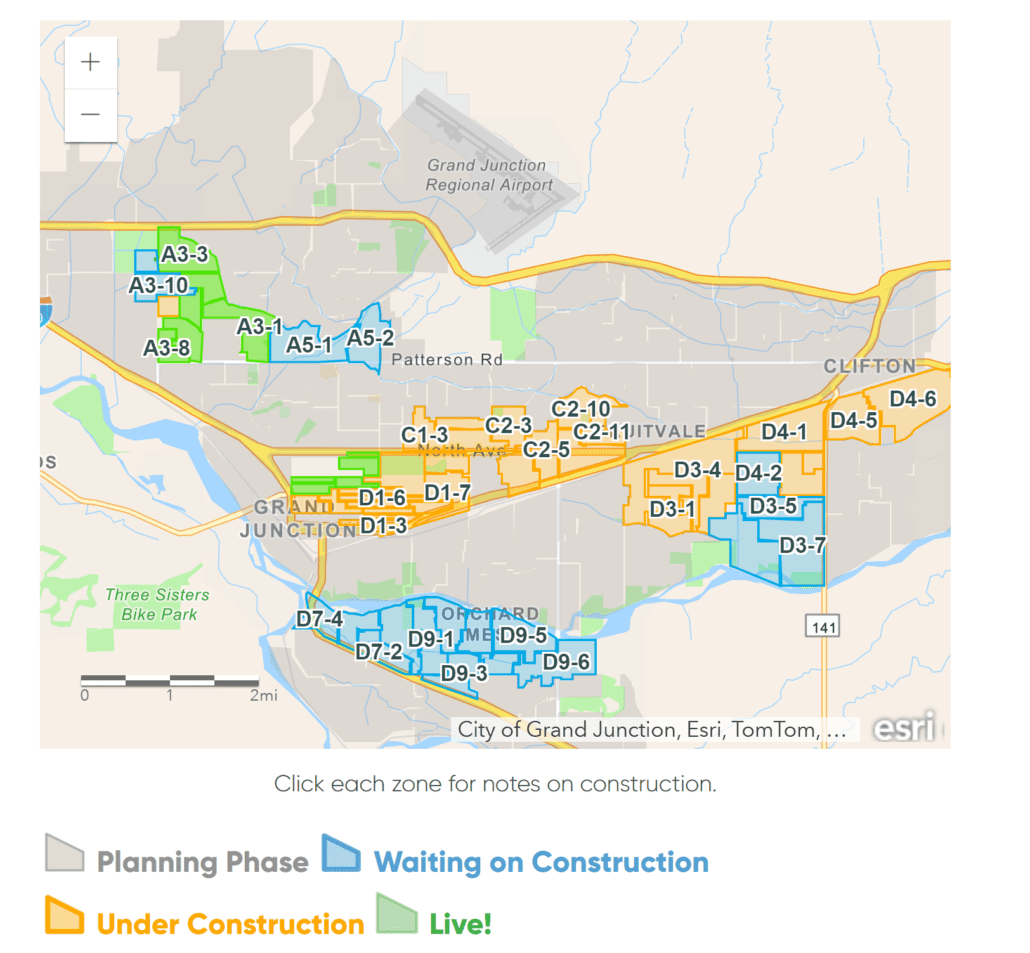
Grand Junction internet providers include high speed internet, broadband and fiber optic, depending on where you live. It is already live in several sections of the community with more under construction. Fruita has high speed internet and Palisade has high speed internet – for the vast majority of homes in those cities. How do you which Grand Junction internet providers serve your property? Here’s a way to find out if you can get fiber optic internet.

Clear Networx offers “Speeds Up-to 1Gps – No Contracts”. Fiber Optic is fantastic technology. Be sure to read about how it’s different than cable internet speeds.

Go to this website, https://clearnetworx.com.

Hover over the Residential tab and you can see the list of communities like Grand Junction, Fruita, Palisade, Montrose, Delta, Gunnison, Ridgway, Durango and more.

Once you choose a city, look for the bar at the top and click on the Construction Map to see where fiber optic is available from Clear Networx. For example, here’s what they look like as of 3/25/25.

Fiber Optic Internet Map for Fruita

Fruita Internet Service Map

Click map for link to Fruita Map online

Palisade Fiber Optic Internet Service Map

Palisade Internet Services

Click Palisade Map for link to map online

Grand Junction Fiber Optic Internet Service Map as of 3/25/25

You can click on the map and zoom in to street level.

Grand Junction Internet Services Map

Click on the map for the online map

If you search Google for who provides internet services in Grand Junction you will see more providers to consider like CenturyLink. Quantum Fiber and Rise Broadband may be an option, but they aren’t available where we live in Grand Junction. Starlink Residential is another option for satellite services anywhere in Colorado. Starlink Mini is a compact, portable kit that can easily fit in a backpack, designed to provide high-speed, low-latency internet on the go. Bring it camping!

Cellular Internet Service in Grand Junction, Fruita and Palisade

Aside from fiber optic, the Grand Valley and Grand Junction internet services are offered by cellular providers as well.

See if your cell phone service provider offers Home Internet Services from cell towers. That’s what we use from T-Mobile. One device gets plugged in and placed in a window facing toward the cell tower in Grand Junction. For the two of us, with Michelle working from home full-time and me occasionally, this meets our needs for about $50 a month. We can easily watch streaming services, and we have an antenna to help get more local channels. If you have a large property, you can look into Wi-Fi extenders for more coverage at your location. T-Mobile Home Internet Service

When we first moved here, we brought our T-Mobile gateway device from Minnesota, plugged it in, and had an instant internet connection. We later upgraded our device when the service “officially” became available in Grand Junction.

Verizon Home Internet Service isn’t available in Grand Junction as of this writing. I checked their website 3/25/25. You can sign up to get notified when it is available.

AT&T offers a service called Internet Air for strong Wi-Fi coverage, check their site for availability and rates.

If your Grand Junction internet service provider of choice is cable internet, Spectrum is your go-to. Don’t worry, they will mail you postcards practically every week once you move in with special offers and sign-up incentives. Visit their website for current coverage and speed options. You can enter an address on their website to determine if service is available. https://official.spectrum.com/sem/internet

Digital Nomads in Fruita, Palisade or Grand Junction

If you are a Digital Nomad investigating living in Fruita, Palisade or Grand Junction you will be happy to know that each community offers several co-working spaces in addition to high-speed internet for your home base.

Here’s a link to a great article the City of Fruita put out called Digital Nomad’s Guide to Fruita. It has many great resources for remote workers in Fruita.

https://gofruita.com/the-digital-nomads-guide-to-fruita

Grand Junction has seen a surge in remote workers, drawn by the potential for a lower cost of living and access to outdoor activities. The entire Grand Valley welcomes and supports remote workers, also known as location independent.
GJEP, the Grand Junction Economic Partnership, has offered a special “Welcome Wagon” Program in the past, specifically for remote workers. We have experienced a tech and remote worker boom. GJEP is a huge resource for work and community in the Grand Valley.

Colorado Ranked #1 in Work from Homeread more on the GJEP website.

As you search the internet for Internet Services in Grand Junction, Palisade and Fruita, just know that there are a lot of options in this growing community for your home or business. We are a bit more rural than Denver or Salt Lake City, but we have fast internet you can count on! If you’d like to learn more about the area and our experience with local internet services, give me a call.

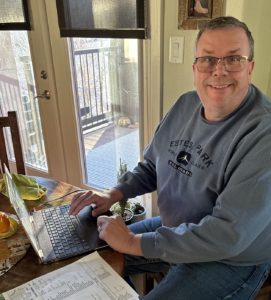
Paul Aspelin working on his laptop at the kitchen tableLet me help you… Move to Grand Junction!
We’ve been waiting for you!

Text/Call 612-306-9558

Paul Aspelin, REALTOR®
GRI, SRES®, CNE

Serving Mesa County – Licensed in Colorado

Connect with me on LinkedIn or send me an email.
Learn more about my experience and how I serve my clients 

© 2025 Paul Aspelin, REALTOR®. MovetoGrandJunction.com. Copyright protected. All rights reserved.

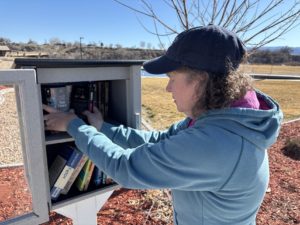
The Las Colonias Little Free Library in Grand Junction

I took a leap toward promoting literacy and community engagement in the Grand Valley. I was instrumental in getting a Little Free Library in Las Colonias in late 2023. Take a book. Share a book. This exciting initiative stems from a passion for supporting local and a commitment to making a positive impact on the Grand Valley community.

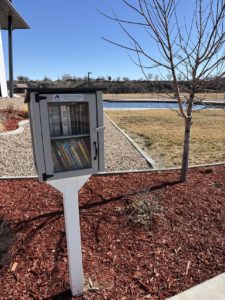
The Little Free Library is located in the Las Colonias Park area near the Butterfly Pond, overlooking the zipline that crosses the Colorado River. A great place for a Little Free Library because it’s where people gather. Look for it by the parking area near the pond.

My wife, Michelle, and I have a connection with local libraries that started with our real estate brokerage in Minnesota. We established a strong relationship with local libraries and their respective friends’ groups. Michelle served on the Board of the Carver County Library Foundation and used her skills to volunteer to make a website for each Friends Group in Carver County, Minnesota.

Las Colonias Little Free Library

Inspired by our library experiences, I knew we had to continue our partnership mentality with the Mesa County Libraries Foundation.

I approached my team at the time with the idea of partnering with the Mesa County Libraries foundation and requested we install a Little Free Library. The response was overwhelmingly positive, and thus, our Little Free Library found its new home in the park. A new partnership was formed. Read my post about Mesa County Libraries and be sure to get your Library Card!

As real estate professionals, we understand the significance of helping individuals with their housing needs. That often involves packing up, decluttering, and donating items. I wanted to become a book drop-off site, encouraging residents in the Grand Valley to donate their books during the process of selling their homes. I had one past client donate a collection of over 1,000 books to our local library. The Friends group was so thankful!

I can come to pick up books from your location. This ensures that the Little Free Library remains stocked and ready for readers to explore new literary adventures.

What sets this initiative apart is the commitment to recycling and promoting sustainability. Recognizing that many home sellers may overlook the value of donating books, the Little Free Library ensures that these books don’t end up in landfills. I will donate any extra books I get to the Friends of Mesa County Libraries. This helps support their weekend book sales that, in turn, generate funds to support local library cultural programming and equipment. It’s truly a win-win for everyone involved!

Over the course of my real estate career, I’ve witnessed the impact of a library partnership, emphasizing the importance of encouraging individuals to donate books. This not only preserves literary treasures but also aligns with my commitment to making a positive difference in the community.

Whether you have a handful of books or an extensive library, we welcome your contribution. (Please NO encyclopedias, textbooks or magazines.) Residents are encouraged to fill our Little Free Library with their favorite reads while discovering new gems to take home and enjoy. “Take a Book. Share a Book.”

If you’re already living in Grand Junction or planning a visit, make sure to swing by the Las Colonias Little Free Library to find your next adventure. Find us on the Little Free Library app!

For those looking to arrange a book pick-up, reach out to me directly at 612-306-9558.

I couldn’t be prouder to initiate the Las Colonias Little Free Library in Grand Junction to help foster community engagement, literacy promotion, and sustainability. By joining forces with the Mesa County Libraries Foundation, we have created a platform for residents to contribute to a more vibrant and connected community, one book at a time.

Little Free Library in Grand Junction

Find us on the Little Free Library App on your mobile device!

Las Colonias Park
1601 Riverfront Dr
Grand Junction, CO 81501

Connect with me on LinkedIn

PAUL ASPELIN, REALTOR®
GRI, SRES®, CNE
Text/Call 612-306-9558

© 2024 Paul Aspelin, REALTOR®. MovetoGrandJunction.com Copyright protected. All rights reserved.


Guest Post written by Michelle Aspelin

Hello! We’ve got parent tips for Colorado Mesa University families and students. Our daughter graduated from CMU in 2022. We are sharing things we learned from discovering the university, doing our research, two campus tours, early orientation, communication with CMU, and tips for lodging and more around Grand Junction.

If you have questions about Grand Junction and the surrounding community, please reach out to Paul Aspelin. We’d be happy to share more parent tips with you or meet up to answer your questions.

Get notifications about new posts and watch Paul’s short videos on our Facebook page called Live Your Vacation in Grand Junction.

Discovering Colorado Mesa University

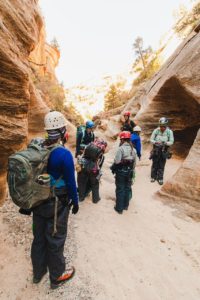
Parent Tips for Colorado Mesa University Families - CMU Outdoor Program trip to Zion National Park

CMU OP trip to Zion National Park for Canyoneering

Colorado Mesa University sent representatives to our daughter’s Minnesota high school to participate in a College Fair. She wanted to go to college near the mountains. After visiting with several school representatives from other states, we had a better idea of what questions to ask. We stopped by the CMU booth on the way out and couldn’t believe what we were hearing. They talked about the University, of course, its size, the majors offered, dorm options, etc. but when they mentioned “Outdoor Program” (OP) our eyes got big. What was that? The rest of the time we spent learning about Grand Junction and what the students can do within a few hours or a day’s drive from campus. Organized, supervised trips every weekend and the OP has gear and ridiculously low fees that students can rent. Camping, hiking, biking, canyoneering, canoeing and more. That was it, she was hooked. Oh, and you can rent a bike from the OP for the school year for very little.

Tip: Remember that your child will be a student at the University but also a member of the community and there is so much to see and do in this area off-campus.

Researching and Comparing CMU to other schools

Excited to learn more, we went home and spent hours on the internet researching CMU and comparing it to other schools. I wish we had one document or guide with parent tips for Colorado Mesa University families at that time. We used the niche.com website to compare the school to other similar schools. That site was very useful. It gives the school “grades” on things like academics, diversity, value, dorms, student life, etc. It gives you a good idea and makes it easy when you can compare all schools with the same metrics.

Tip: You can’t always trust everything you read. You won’t really know until you experience it for yourself.

We did other research and considered those sources as well. Grand Junction is a small community with urban and rural features. We thought crime was high compared to other areas so during one of our campus tours I asked about it. They said the most common crime is bikes getting stolen. And we later found out that crime within the surrounding community was overreported. For example, if there was an incident and 5 people called it in to the police department, it got counted 5 times vs only as one incident.

Colorado Mesa University is one of the least expensive universities in Colorado and if our daughter wanted a chance to go to school near the mountains, this was it. So, we decided to take a family vacation and tour CMU and the University of Wyoming at Laramie. We flew into Denver and drove to Grand Junction. Did the tour and left after that for Wyoming.

Tip: When you come to visit the school, give yourself 2-3 days to tour around the area as well as the campus. See Paul’s post that includes a two-day itinerary of what to see and do in Grand Junction. We exited I-70 at the Clifton exit so we didn’t even know there was an airport or a super cute downtown area.

Two Campus Tours

We did the standard 2-Hour campus tour the summer before our daughter’s Junior year of college. She started looking early. It was the first college campus we visited. We asked a lot of questions, seeking parent tips for Colorado Mesa Universities families ourselves! After looking at 3-4 more she chose CMU. We flew to Colorado from Minnesota in March to do the extended tour called The Mesa Experience. It’s a full day event where you tour the building that would have most of your classes for a particular major. And there was an informal reception the night before. THAT was a fantastic experience and a great way to really get to know the school. That confirmed her choice. She applied and got a merit scholarship to help cover the costs of the out-of-state tuition. Because of her scholarship, the cost was about the same as if she attended a MN state school.

Tip: If your student is considering CMU from outside of Colorado, be sure to apply early and consider a merit scholarship to reduce the cost of tuition. It can save you up to $7500 annually for each year of attendance.

Tip: If you live in Colorado, look up The CMU Promise. “CMU promises an opportunity for a better life through education. If your family earns $70,000 or less the cost of your classes is covered and we will teach you how to think, not what to believe.”

Early Start Option called FYI

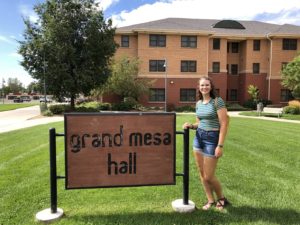
Freshman Year Dorm

This was so worth it! Because we lived out of state, our daughter didn’t attend the standard Orientation the summer before she started at CMU. Therefore, we brought her a week early to participate in FYI (Freshman Year Initiative). That was one of the best decisions. She got to move in early when it wasn’t so crowded and learn more about the campus before all of the students arrived. She went to class and earned 2 elective credit hours that week. She met most of her roommates as they came early too. She became friends with others in her class that have become live-long friends. She even met her future husband during that time!

CMU describes FYI as a chance for students to ease into the transition from high school to college. We knew our daughter was prepared academically, this helped her in other ways, and she loved it.

Tip: It was a wonderful experience for us parents too. Getting to know the other parents on move-in day and discovering more about the campus in a less crowded environment.

Tip: Read Paul’s post about which water bottles we have, why we chose them, and where to get them locally. Make sure your new student has several water bottles.

CMU Communication

Our daughter started fall of 2019. She completed one “regular” semester, then covid hit in March 2020. They were forced to move out and finish their semesters at home. The current CMU President, John Marshall, was the Vice President at that time and he lead a wonderful team with a health major professor to keep us parents informed during covid. They did group phone calls were we could ask questions. They held Facebook Live chats where they kept us informed and we could ask questions. They communicated frequently via email.

The following fall the were able to accommodate all students coming back to campus and having a mix of in-person and online classes when most larger universities only offered online classes. They are so committed to serving their students. I remember raving to my friends what a great job they did communicating and my friends with kids at other colleges were jealous.

Their website is a great resource, lots of information and easy to search.  They have a Resource section for Parents and Families. You can follow them on social media, there is a Facebook group for parents. And once your student is accepted, they send frequent emails explaining the process and the opportunities. As a parent of an alumni, I still get some emails from John Marshall when he has news to share and I love it.

Lodging for CMU College Visit

We stayed at the Holiday Inn Express near the Mesa Mall on our first visit. When we came for The Mesa Experience, we stayed downtown at the Fairfield Inn & Suites. For visits over her attendance at CMU we stayed at the La Quinta near the airport. All were great. I recommend staying downtown on at least one visit to immerse yourself in the downtown area. It’s a real gem. Shops, dining, entertainment, artwork, and now there’s a CMU store on Main Street!

Hotel Maverick opened after she graduated. We have dined there but have not stayed. I think that would be a great immersive experience as well. Their food is fantastic as well as the roof-top views.

It’s very easy to get around Grand Junction. If you fly here, check out Paul’s post called The Grand Junction Airport Experience. Our 6-gate airport with rental cars on site is very impressive!

Get an REI Membership

One more tip. If you don’t have one already, walk into the local REI store, ask for Josh Kolb (our son-in-law) and get signed up for REI Membership, and maybe the REI credit card. When we dropped our daughter off, we went to REI and bought her a mountain bike and a heavy-duty lock. She had a sleeping bag and water bottle and that was about it. She made many trips to REI while she was in school and took advantage of their sales and their generous return policy. They take back used items if they don’t work out for you and resell them in the “garage sale” section of the store. The store is a great asset to the community because there are so many opportunities for outdoor adventures around here.

Overall CMU Experience

We hope you have enjoyed the parent tips for Colorado Mesa University families. Overall, it was a wonderful experience as a parent to have our child attend CMU. She absolutely loved it, especially weekend trips with her friends to so many great places. Lots of laughs and life-long friendships.

Why we moved to Grand Junction

Parent Tips for CMU Families trip to Arches National Park

Parents Weekend trip to Arches National Park

I’ll never forget Parents Weekend the first year. We came in October for a short visit. On the day we left, we met our daughter at the library on campus and got bagels and coffee. We watched her walk off to class and we sat outside to eat our breakfast. The sun was warm on our faces, it was in the 70’s and we were captivated with the area and the warmth. We said to each other that we could see ourselves retiring here someday. That was 2019.

We kept that thought in the back of our minds until after our second daughter went to Arizona for her college experience. They both said they weren’t coming back to Minnesota. So, we put our plan in motion and moved to Grand Junction in 2023. No regrets whatsoever. We created this website a few months later and have been so thankful to be here and discover everything around here. It’s been one of the best decisions we have ever made. You can read Paul’s post about what we learned in the first 3 months of living here and other posts about our transition and the move across-country.

And if you want to look at any houses while you are here on a visit, connect with Paul. He’d be happy to show you properties currently on the market or about to be listed. Read more about his real estate experience on the About Paul Aspelin page.

P.S. One more tip, read our post about Retiring in Grand Junction because CMU also offers classes for those 60+ at a discounted rate using their CMU Golden Scholars Program!

Written by Michelle Aspelin

© 2024 Paul Aspelin, REALTOR®. MovetoGrandJunction.com and Michelle Aspelin Copyright protected. All rights reserved.

I-70 Colorado: What it’s really like driving I-70 from Denver to Grand Junction CO

Whether you are an experienced driver or not, driving the I-70 Colorado stretch over the Rocky Mountains has some additional considerations to be aware of and plan for.  I want to share some of my experiences with you so you will be more prepared than we were that first time. I must say, following advice from the locals regarding driving I-70 Colorado is extremely important. It’s a stunning drive but it has its ups and downs too, pun intended! I want you to be safe, proactive, and enjoy the drive.

I post short videos and announce new website posts on my Facebook page called Live Your Vacation in Grand Junction.
Follow Live your Vacation in GJ on Instagram.
Follow Move to Grand Junction on YouTube.

Driving I-70 Colorado from Denver to Grand Junction CO

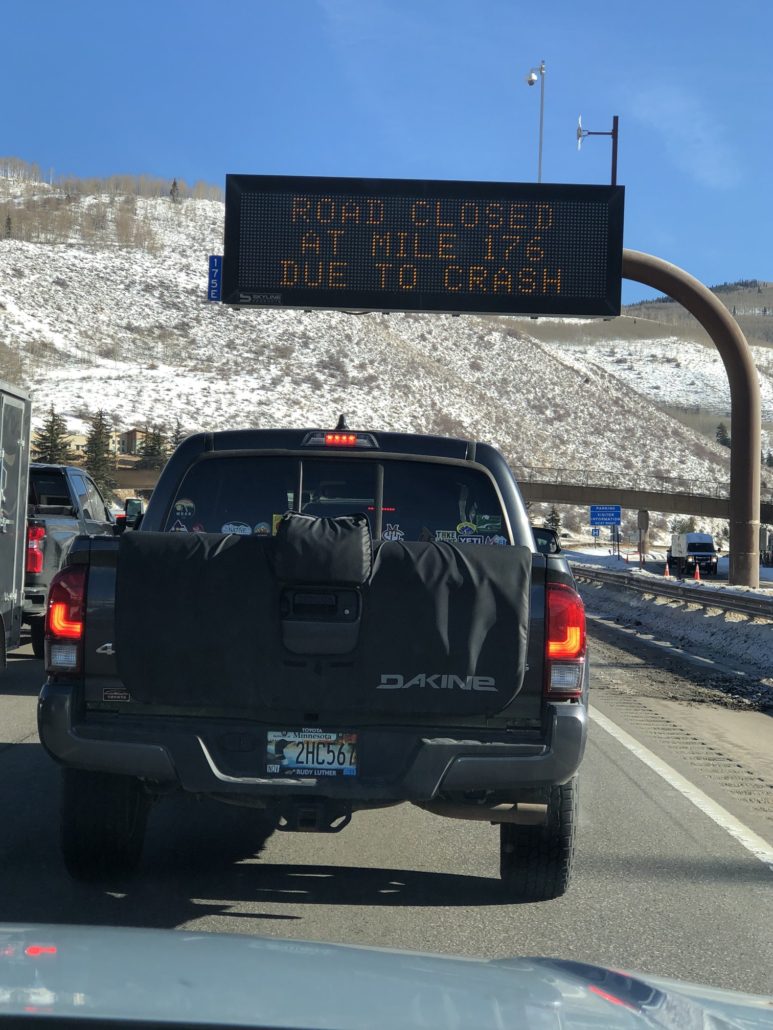
The “crash” indicated on the digital sign was actually snow on the interstate caused by the avalanche near Vail Pass. That’s our Toyota Tacoma we are following!

#1 I-70 Colorado isn’t always open to traffic in one or both directions

I-70 Colorado playing Monopoly during traffic jam

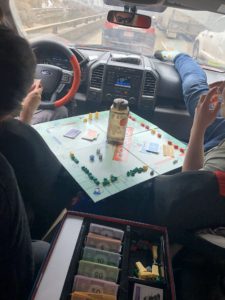
Unexpected boulder crashed into a semi truck on I-70 means it’s time for a game of Monopoly!

The main thing to know is that I-70 is unpredictable. I have been detoured multiple times over the years and that can add hours to your commute. You can’t simply exit the interstate, drive along a frontage road, then hop back on at the next exit. It is nothing like driving interstates around the country. I-70 is unique.

I have had to detour because of

  • The 2020 Grizzly Creek forest fire near Glenwood Springs that burned over 32,000 acres resulting in a 13-day closure of the interstate.
  • The July 2021 mudslide in Glenwood Canyon the following spring due to the forest fire. That closed I-70 for about two weeks. The detour was Grand Junction to Steamboat Springs then to Denver, yikes!
  • And in December 2022 there was an avalanche near Vail that was triggered by a backcountry skier. Luckily this time we detoured around Vail pass via Leadville, but it added several hours to our drive. It closed several more times for avalanche mitigation that season.
  • The summer of 2024 & 2025 we avoided the westbound Idaho Springs stretch several times due to construction. Backups can go on for miles and miles, especially when it’s down to one lane and the lead vehicle is a slow semi-truck… going uphill! Yeah, we saw that while driving east and said there’s no way we want to get stuck in that!

I had friends stuck in their vehicle on I-70 because a boulder crashed into a semi-truck, unable to exit, and they played a full game of monopoly during the wait. Car fires happen more frequently than where we used to live and so the interstate gets shut down for those too. And then there are vehicle accidents that shut it down as well. You can also imagine the role weather plays, but especially during the winter months. In winter you need 4-wheel drive or chains for your car in order to go over the passes on I-70. That’s the law.

Advice for driving I-70 through Colorado

driving I-70 Colorado from Denver to Grand Junction CO smoke from car fire

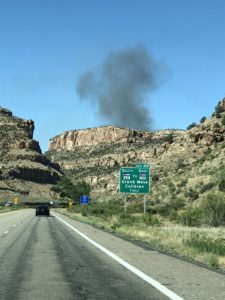
Smoke from a car fire while driving I-70 from Grand Junction to see a client on the Grand Mesa.

Be proactive when you make plans. Do not rely on it being open. If you want to fly into Denver and drive to Grand Junction CO, check the news and Google maps first. And if you are driving from Grand Junction to catch a flight out of the Denver airport, drive to Denver the night before your flight, not the day of. Give yourself a buffer in case there is a delay.

Download the Colorado Road Conditions app called CO Traveler. This app will help you with traffic expectations and there is a layer you can apply to the app for weather conditions. You can see if the roads are dry, wet, icy or snow covered.

Cell service is spotty. Keep track of your progress as you drive and update the travel app or Google maps. You most likely will lose cell service in the Glenwood Canyon as you stare up at the 100’ walls that surround you.

Know how to downshift your vehicle. If you are renting a car in Denver, DO NOT leave the rental car parking lot until you know how to downshift the vehicle you rented. Look up downshifting videos on YouTube prior to your trip if you have never driven on roads with 5-10% grades. You do NOT want to rely on your car brakes as they can get too hot and fail.

Leave with a full tank of gas or a full charge on your electric vehicle. If you get stuck on the interstate and cannot exit, you may use a lot of gas/range to idle your vehicle if you need the AC or heater. And if it’s wet, make sure you have plenty of windshield washer fluid too.

How to make the I-70 drive through Colorado more comfortable

I-70 Colorado be prepared with water bottles

Our YETI Stainless Steel Reusable Water Bottles are also dishwasher safe. We haven’t added the stickers to them like most people LOL.

Drink plenty of water. Being at a higher elevation can take a toll on your body. Especially if you fly to the Denver airport and are driving to Grand Junction all in the same day. You get dehydrated faster at higher elevations even if you are not exerting yourself. Drink water or choose something with electrolytes like Gatorade, Propel, or purchase electrolyte powders to add to your drinks. Avoid tea, coffee and pop. Or, if you drink those, offset it with an equal or greater amount of water.

Invest in a good stainless-steel water bottle you can refill frequently. People in Colorado carry their water bottles everywhere. Good hydration is important and having your own bottle makes it very easy and keeps plastic bottles out of the environment. Read my post called Water Bottles 101.

We found that taking Vitamin C can be helpful to avoid altitude sickness. Start to take a Vitamin C supplement a day or two before your trip to Colorado. Check with your physician first, and your pediatrician for your children, on how to feel comfortable in higher elevations. Read my post called How to Avoid Altitude Sickness for more advice.

Take your time. Stop frequently at the numerous rest stops along the way. Get out and walk around. You’ll probably need to use the bathroom anyway, so plan on extra stops. Rest stops are typically a great source of materials about the area and fun local and historic information to look at.

Bring snacks. Whenever you are driving for over 2 hours, always pack snacks. Bring something salty to help your body absorb the extra water you are drinking. Nuts and trail mix make a good snack.

You might want a small cooler for your drinks and any chocolate you bring because it may melt in the car and that would be horrible. The sun is HOT here because we are closer to it. Read my post about Grand Junction Weather.

Take turns if you are driving with others. Allow the primary driver a chance to rest and look at the scenery too. Switch off driving every couple of hours.

What it’s really like to drive I-70 through Colorado

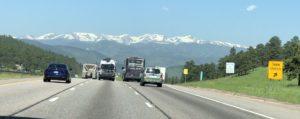
As you head West from Denver to Grand Junction, you leave the city and the interstate turns into a very long, slow climb that will be difficult on your vehicle. Your car or truck may need to use all the energy it has to climb this part of the Rocky Mountains. When I drove our Toyota Rav4, towing an 8-foot U-Haul, I had it floored and our max speed was 40 miles per hour, no joke! When you see it start to incline, make sure you are driving at least the speed limit because it’s difficult to speed up once you start uphill. Now, if you have an 8-cylinder truck, you probably won’t have issues, but you will be burning through a lot of gas too!

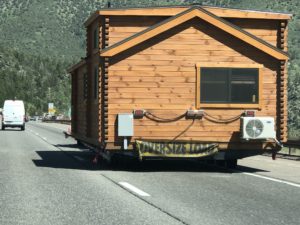
 I-70 Colorado Rocky Mountains from Denver to Grand Junction CO wide load

We had to follow this wide load for miles before there was enough of a shoulder for his oversized load and we could pass.

Absolutely stay in the right lane unless you are passing. It is the law in Colorado. Pay attention to the trucks as they go abnormally slow up the steep inclines. Vehicles driving slower than the speed limit generally have their hazard lights on full time. Be patient as you will get stuck behind a slow-moving truck or car at some point and the traffic in the left lane will be speeding by. It’s difficult to pass sometimes, so just wait until you have plenty of space. Try not to pass on an incline.

The Eisenhower/Johnson Tunnel is at the Continental Divide, the “top” of the Rocky Mountains at an elevation of 11,112 feet above sea level. BE PREPARED as you start to exit the tunnel. It’s like the green starting flag was just waived at the Indy 500 as everyone drives like a bat out of hell, downhill, jockeying for position. The actions of the more experienced I-70 drivers can be just as intimidating as the steep downgrade. Once you reach Silverthorne/Dillon, I recommend exiting at this time so you can pry your hands with white knuckles off the steering wheel and take a break until your heart rate returns to normal. You need to be very attentive at all times, making it strenuous. Don’t let those runaway truck ramps intimidate you, but understand they are there for a reason, and yes, they do get used!

Update: In July 2025 we were driving back to Grand Junction from Michigan. It was somewhat cloudy when we entered the tunnel on the Denver side. But when we came out the west side, it was pouring rain! Water was pooling on the highway, a lot of water. I flung on my windshield wipers and slowed down so we wouldn’t hydroplane across the interstate. That was unexpected! By the time we got to Glenwood Springs it was very dark. I don’t recommend driving it after dark. We were so tense from constantly looking for deer. And you don’t get to see the impressive scenery.

driving I-70 Colorado - from Denver to Grand Junction chain up area

We chuckled the first time we saw the “chain up” signs and the pull-offs for the truckers.

There’s another high pass around Vail. So, when you descend after Denver, that’s not the end. You will go up and over Vail pass and it can get a bit chaotic then too with other people speeding in the left lane, making it hard to pass and drive at a good pace for you. Always be watching the traffic around you. Cars come up behind you, out of nowhere, and vehicles you’re following suddenly move into the passing lane leaving you unknowingly racing up on a slow-moving semi.

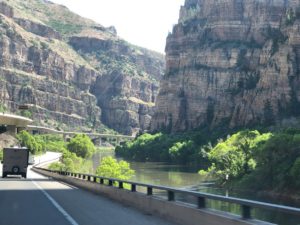
It gets easier after Vail. Near the town of Eagle, the mountains open up and there feels like more room. Then you approach Glenwood Canyon, the most expensive stretch of interstate ever constructed in the United States. You’ll enjoy going down and following the Colorado River as you look up at the canyon walls. Very pretty. Watch your speed through the canyon as there are sharp turns where you need to slow down quickly.

I-70 Colorado

Driving near Glenwood Springs CO along the Colorado River

After all the ups and downs, curves and beautiful scenery, you come around this curve right before Palisade and it will begin to open up into the Grand Valley. You’ll see vineyards and peach orchards along I-70, yes, those famous Palisade Peaches (so juicy)! The Book Cliff mountain range will be on your right, they go all the way into Utah.

As you enter Palisade, you will get a better view of the world’s largest flattop mountain, the Grand Mesa. And to the southwest you will see the Colorado National Monument off in the distance. Grand Junction is surrounded by beautiful mountains with the city at 4,600+ feet above sea level.

Once you come out of the De Beque Canyon you are just 15 minutes to Grand Junction. There are a couple of exits to take. Horizon Drive is the most popular exit, check out the cool rotary with some metal wild horse sculptures in the middle. It’s right near the Grand Junction airport (small airport with 6 gates, but hardly ever busy!) Read about my GJT airport experience.

Once you complete your drive, keep drinking water. If you can, abstain from alcohol on your first night in town. Give yourself a chance to adjust to the higher altitude. If you get a headache, drink more water. And once you get out and explore the area, always wear sunscreen as you can burn your skin within 15 minutes when you come in the summer months.

Hopefully you find this information useful. Driving I-70 through the Rocky Mountains of Colorado is an experience you will never forget. Be safe. Plan ahead. Be prepared. Be patient. Be flexible. Have your passengers take lots of photos to show your friends!

I70 Colorado rest stop near Colorado River in Eagle, CO

Beautiful Rest Stop in Eagle on I-70

Text/Call 612-306-9558 me with any questions you have about driving I-70 from Denver to Grand Junction CO or the Grand Valley in general.

Follow me on Facebook: Live Your Vacation in Grand Junction

PAUL ASPELIN, REALTOR®
GRI, SRES®, CNE

Grand Junction Real Estate Expert
Connect with me on LinkedIn or send me an email.
Learn more about my experience and how I serve my clients 
© 2024 Paul Aspelin, REALTOR®. MovetoGrandJunction.com Copyright protected. All rights reserved.


Winter Weather in Grand Junction

Retirement Weather Expectations Redefined When You live in Grand Junction

When considering a retirement destination, people often focus on housing, proximity to family, cost of living, access to healthcare, quality of life, state tax rates, winter weather, and even job opportunities. However, the one aspect that often tops the retirement location list is mild winter weather. Regardless of your personal reasoning, I urge you to explore why the winter weather in Grand Junction stands out as an ideal location for retirement.

Winter Weather in Grand Junction

For many retirees, the idea of escaping harsh winter conditions is a key factor in choosing a new home. Grand Junction, nestled in the heart of the Grand Valley, boasts winters that are mild in temperature and snowfall compared to other parts of the country. Unlike regions with challenging winters, the Grand Valley provides a comfortable climate that enhances your retirement experience. Read my post about Grand Junction Weather.

Cold Weather States

In colder weather states, there’s an unspoken expectation that retirees are required to only head to warmer destinations, like Florida or Arizona, to escape winter’s grip. However, Grand Junction challenges this norm. The decision to retire here isn’t solely about avoiding winter; it’s about embracing a balanced lifestyle and experiencing all four seasons. The Grand Valley offers something unique—a place where you can enjoy the benefits of winter without the extremes found in other cold-weather regions. You don’t have to give up winter altogether.

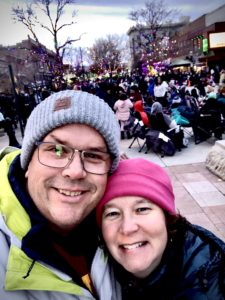
Grand Junction Parade of Lights

Grand Junction Parade of Lights

Enjoy the Change of Seasons

I was well aware of the mild winters before moving to Grand Junction. It wasn’t until I made the move to Grand Junction that I realized how much I still appreciate the joy of experiencing distinct seasons. Having lived through the brutal winters of Minnesota, I developed a genuine love for the season and winter activities, just not 6-8 months of it!

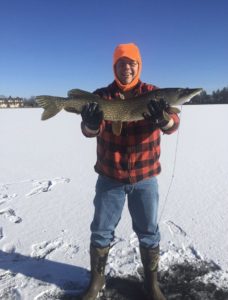
Retirement in Grand Junction means you can still enjoy the enchantment of snow-covered landscapes and the seasonal activities that winter provides. With ice fishing being a part of my DNA, a quick trip to the Grand Mesa can easily fulfill my desire to be outdoors on “hard water” as we called it in Minnesota.

You can embrace a half day of skiing at Powderhorn Mountain Resort in the morning and an afternoon round of golf at the Redlands Mesa Golf Course in the same day. If that sounds like a great day, then Grand Junction is right for you. Read my post about Golf Courses in Grand Junction.

We have enjoyed the Fruita Parade of Lights and the Grand Junction Parade of Lights without freezing. In fact, I recommend the extremely chocolatey Polar Express hot chocolate from Main Street Bagels, only available the day of the Grand Junction Parade of Lights.

Sunshine Year Round

One of the standout features of Grand Junction is the abundance of sunshine throughout the year. I believe the stat is 300+ days of sunshine? Unlike the gloomy winters experienced in some states, the Grand Valley enjoys a remarkable amount of sunshine. No more seasonal depression brought on by cloudy grey skies here. Yay Colorado desert!

Warm But Not Too Hot

You might consider New Mexico, Nevada, or Arizona as your warm weather destination. But those places can be really hot! Almost unbearably so. I had a friend move from Minnesota to AZ with her husband after she retired. Every summer she spent indoors to be in the air conditioning. Similar to when Minnesota residents “hibernate” until spring. It was too hot for her to enjoy Arizona year-round. She ended up moving back to Minnesota.

It gets warm in Grand Junction but not so hot that you can’t enjoy the summer outdoors. Yes, you have to keep yourself hydrated and be aware of how you feel if you go up in the higher elevations (read my post about Avoiding Altitude Sickness). But it’s a “dry heat”. Read what it means to be in the Colorado desert on my Grand Junction Weather post. We don’t have the high humidity like the southeastern United States.

Redefining Retirement Expectations

Grand Junction, with its mild winters, abundant sunshine, and a perfect balance of seasons, challenges the traditional notion of needing a warm destination for retirement. If you’re ready to redefine your retirement expectations and embrace a diverse and enjoyable lifestyle, consider living in Grand Junction as your next home. Read my post about summer weather in Grand Junction.

The Grand Valley has something to offer everyone, making it a truly special place to begin this new chapter of your life. Please connect with me early in your destination search and allow me to show you all the Grand Valley can offer.

Read my posts about the many reasons to choose Fruita, Grand Junction or Palisade. I can help you find just the right property in Mesa County.

Let me help you, Move to Grand Junction!

We’ve been waiting for you!

Text/Call 612-306-9558 with your questions.

Paul Aspelin, REALTOR®
GRI, SRES®, CNE

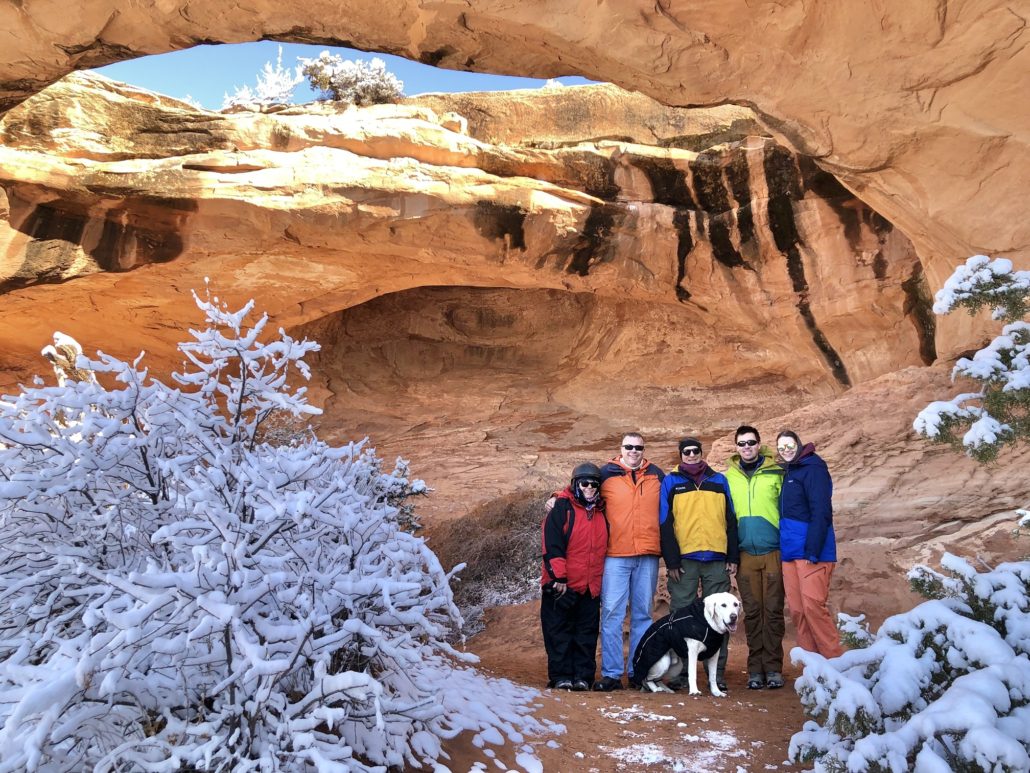
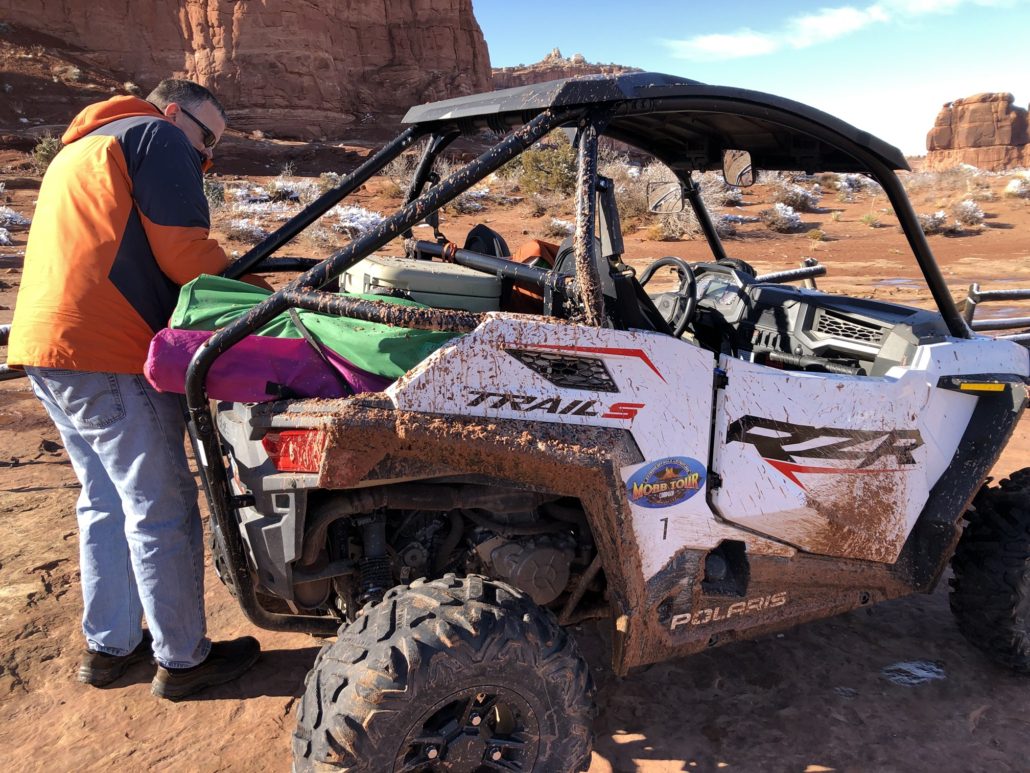
In November, we rented a Polaris RZR ATV and got to ride on trails all day in Moab, UT. We went to Uranium Arch and other great spots. A fantastic winter activity with family and friends! It was a little muddy the day we went because it had just snowed, but it was so beautiful!

© 2023 Paul Aspelin, REALTOR® MovetoGrandJunction.com. Copyright protected. All Rights Reserved.

Uranium Arch in Moab, UT

Moab ATV Riding

Grand Junction Weather Summary by Month

So, what is the Grand Junction Weather like you ask? Read this monthly summary before you travel to the area for a visit or make your move to Grand Junction. When it comes to packing your clothes, layers work best here in every season.

Choosing to live in the high desert of the Grand Valley in Colorado offers a unique and appealing lifestyle for various reasons. The term “high desert” refers to an arid region that is elevated in altitude. In the case of the Grand Valley, it encompasses Fruita, Grand Junction, Palisade, and its surroundings in Mesa County.

One compelling reason to live in the high desert is the climate. The Grand Valley experiences over 300 days of sunshine annually, coupled with low humidity. This results in a dry climate, making the region ideal for those who appreciate brilliant clear blue skies and a distinct four-season climate. The dry air also contributes to the stunning landscapes, with the Book Cliffs, Colorado National Monument, and the Grand Mesa providing breathtaking views.


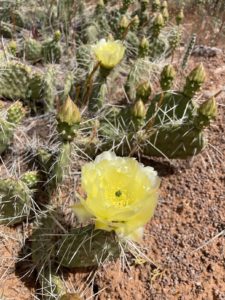
Spring flowers in the desert. Photo Credit: Emma Aspelin

Winter and Early Spring Weather

Grand Junction, CO boasts a diverse climate, with each month offering a unique weather experience. In January, temperatures range from an average high of 38°F to a low of 18°F, providing a crisp winter atmosphere. February sees a slight uptick, with highs around 45°F and lows near 24°F, hinting at the imminent arrival of spring. Relief is on its way already! Read my post about winter weather in Grand Junction.

Spring Weather

As March unfolds, Grand Junction experiences a pleasant transition, with average highs reaching 56°F and lows hovering at 31°F. The arrival of spring brings a burst of vibrant colors as early spring flowers, such as tulips and daffodils, bloom. Typically, these delightful blossoms begin to emerge in late March to early April, adding a picturesque touch to the landscape.

Spring fully emerges in April, painting the landscape with vibrant blooms from more plants, as temperatures climb to an average high of 66°F and a low of 38°F. Making it a great time to hike! May showcases the region at its best, boasting comfortable highs of 76°F and lows of 47°F.

Hiking and biking in the Grand Valley is a wonderful experience in the springtime, but avoid the trails if the are wet. Riding on a wet trail will form ruts when it dries, making it extra bumpy for riders until the next rain, which is infrequent.

Fall on the Grand Mesa

Fall on the Grand Mesa

Summer Weather

With the arrival of summer in June, Grand Junction basks in warm temperatures, with an average high of 89°F and a low of 57°F. July, the peak of summer, offers the warmest weather, featuring highs around 94°F and lows near 63°F. August maintains the summer heat, with temperatures ranging from an average high of 92°F to a low of 61°F. But don’t worry, humidity is low, so heat isn’t so bad. Keep drinking water.

Palisade is renowned for its wineries and vineyards, taking advantage of the unique Colorado desert. The warm days and cool nights are loved by the grapes, peaches, apples, and other plants in the area. Ready my post about Crawford State Park or Ridgway State Park for places to get into the water during the warm summer months. Read my post about summer weather in Grand Junction.

Fall Weather

As fall unfolds in September, Grand Junction weather experiences a pleasant cooldown, with average highs at 82°F and lows at 51°F. Leaves start to turn up on the Grand Mesa. October ushers in the beauty of autumn, showcasing highs of 68°F and lows of 39°F. Leaves start to turn color in the Grand Valley, it’s beautiful. Roses still bloom in late October! November sees a gradual shift to winter, with average highs dropping to 51°F and lows reaching 28°F. Very manageable.

Ice Fishing Riffle Gap State Park in December

Ice Fishing Riffle Gap State Park in December

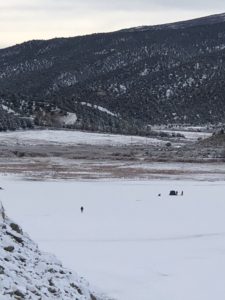
In December, Grand Junction embraces winter’s chill, with average highs at 40°F and lows at 20°F. But it’s not too cold to enjoy the seasonal Parade of Lights in Fruita and Grand Junction. We saw these people ice fishing in Riffle Gap State Park in December!

Grand Junction weather highlights the city’s diverse climate, making it an ideal destination to live year-round. Get today’s forecast from the locals at KKCO First Alert Weather.

Overall, living in the Colorado desert of the Grand Valley combines a distinctive climate, stunning landscapes, outdoor recreation, making it an appealing choice for residents seeking a unique and enriching living experience. Read my post about golfing year-round at Grand Junction golf courses.

Learn More

Thinking about moving to Fruita, Palisade, and Grand Junction Colorado? Find out what makes each city unique.

Let me know if I can help with your search for the best property in Mesa County to meet your needs! We are waiting for you!

Call or text me with your questions! 612-306-9558

P.S. If you ever want to go ice fishing, give me a shout! I’m always looking for a friend to fish with.

Connect with me on LinkedIn

Paul Aspelin, REALTOR®
GRI, SRES®, CNE
Grand Junction Real Estate Expert

© 2023 Paul Aspelin, REALTOR® MovetoGrandJunction.com. Copyright protected. All Rights Reserved.